Seven Leadership Storytelling Best Practices Inspired by the Best IG Reels
It is really true what philosophy tells us, that life must be understood backwards. But with this, one forgets the second proposition, that it must be lived forwards. - Kierkegaard from his Journals (1843, entry IV A 164, Alexander Dru translation. Source: wist.info/kierkegaard-soren/35849/)
I want to shout out to Dia, who brought this quote to my attention. Dia is in my summer course on story and identity, as part of my work with Their Story is Our Story, which elevates the voices of refugees and allies. I am learning so much from this program (and I’m supposedly the teacher!).
Life must be understood backwards.
Bear with me for a moment as we unpack this. Consider that a lot of stuff has happened to you, for you, and, in general, in your life. For however many years you’ve been on this earth, things are happening every second of the day. What you make of it is the story. While you’re in it, it’s the messy middle, so you have no idea what the story is.
It’s in hindsight that you can make sense of it.
Life must be understood backwards.
If you are like many of the people I talk to each day who would like to be better at telling stories, I suggest an understanding of “the backwards” would help. It takes some reflection and analysis.
If someone were to ask you how it is you came to do the work you do, your first instinct might be to say it’s not really that interesting and then recite the chronology of events that brought you there. But if you take a moment to identify the themes in your life, or a recurring emotion or pattern, you can begin to uncover a thread that could weave through your story. Or maybe there was something you wanted to do in your life, and here you are doing something else. Explain the gap, then connect it.
You see, you can choose how to narrate the past.
Why bother doing this? I know, you have a lot of work to get done. Why take the time? You could be their boss, a co-worker, a fundraiser, an executive director, a CEO, an entrepreneur. You could be running a household, a business, or a nonprofit. You could be growing in your career, someone who believes in an idea or message and working to grow a platform.
People want to know you. They want to trust you, feel aligned with you, and be inspired by you. There is no other way to do that than through stories.
It doesn’t matter who you are; the same fundamentals apply. We must understand the incidents in our life backward and be able to tell the story.
Now, I’m not just talking about your life story. It could be little moments in your life, or work-related experiences - storytelling doesn’t have to include your big narrative.
I have a growing list of best practices for leadership storytelling, each of which is exemplified by a saved reel in my Instagram favorites.
Bring complex ideas to life with a metaphor (and story): Karishma Porwal is the Climate Girl and uses tomatoes as a metaphor for oil to explain OPEC. It’s complicated, yet through tomatoes, we can understand.
Emotions are contagious: Unabashedly share your feelings. Use this one with caution, of course, but be inspired by this video from the World Cup. I don’t even know what he’s saying but I get it, and I’m tearing up just watching. Don’t overshare, don’t dramatize. Be you.
In fact, there is a vulnerability to sharing your emotions. And when you are vulnerable, your team feels more connected to you and safer in their own space. I mean, here is Mikaela Shiffrin* talking about self-talk and self-doubt. Mikaela is the most decorated American alpine skier in World Championships history, and if she has these feelings, we can have them too. When you make space for these kinds of emotions, people feel permission to be themselves around you.*
Highlight the unexpected: like this video that describes Phil Collins’ iconic song and drum riff played while he looks like the company’s IT guy. What’s unexpected about you?
Be relatable: Here’s Abby Wambach idolizing Taylor Swift because of her ability to “tell me what I’m thinking.” When we articulate an idea or an emotion, it helps people understand themselves better, articulating something they didn’t previously have the language for.
Show us behind the scenes: Admittedly, your project might not be as cool as the K-pop Demon Hunters’ performance at the 2026 Oscars, but watching them prepare behind the scenes is amazing. People like seeing the sausage being made!
Laugh at yourself: Fredrik Backman is a writer. He might think his life is uninteresting, but he has created a narrative that’s anything but, and he doesn’t take himself all that seriously, which the audience found incredibly endearing.
Find full-circle moments - they are remarkably appealing. This one is about me. I didn’t know what I wanted to be “when I grow up.” Having no plan, I moved to Colorado to ski and wait tables. I finally put my college degree to work at age 30, with a job in the corporate world in Seattle. One day, I came into work to learn that my employer had purchased a ski resort. Then the marketing director at the ski resort resigned to get married, and they offered me the job.
There was no plan. While it was happening, there was no story. As I look back and piece together the different parts, it feels like a full-circle moment, and people love hearing it. Told a different way, it could be boring - there were a lot of things that happened during that time that don’t fit and that don’t matter.
Don’t fall into the trap of thinking your story isn’t interesting because it didn’t happen by design. With the benefit of that 20/20 hindsight, pick a moment from the past: A job you took, a plan that fell apart, a decision that made no sense at the time, and connect the dots now, even though there weren't any at the time.
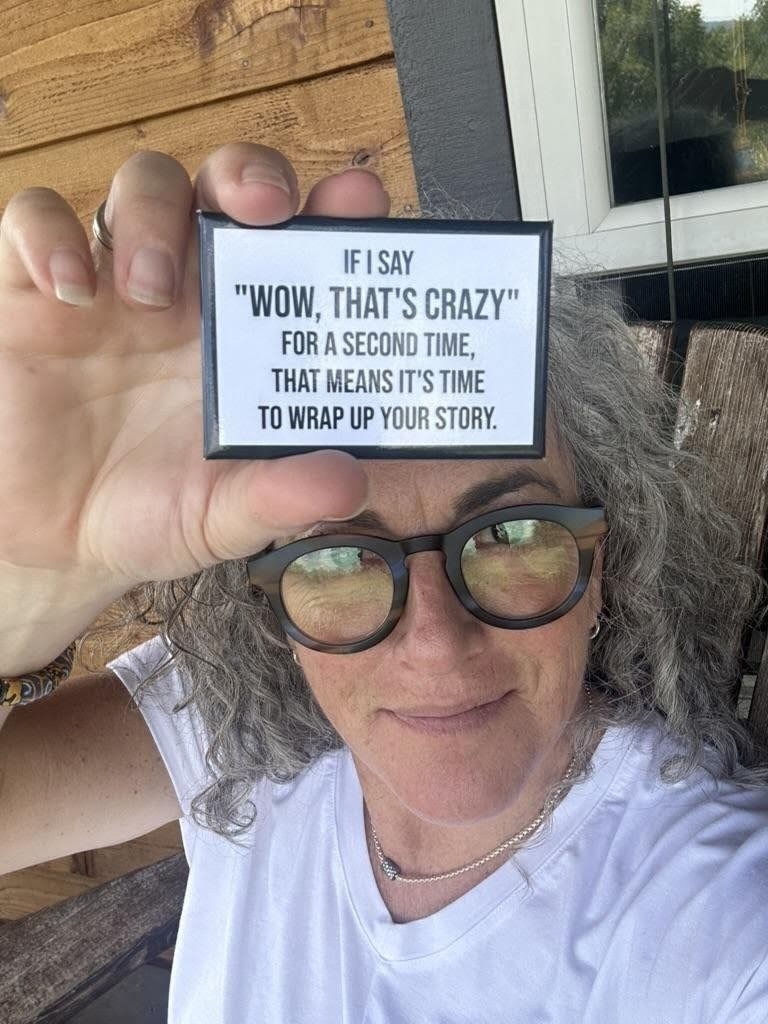
PS: Whatever you do, don’t overdo it on the details, because, and one last favorite: